Sports partnerships are easy to get excited about. There is the announcement, the new livery or shirt, the access to athletes and the opportunity to put your brand in front of an audience that already cares deeply about what it is watching.
For a business looking to grow, the appeal is obvious. You are not just buying advertising space. You are trying to become part of something people choose to spend their time, money and emotion on.
But an exciting opportunity and a good investment are not necessarily the same thing.
What interests me is what happens after the announcement. Does the partnership give people a reason to notice the brand, understand it and eventually choose it? Is the business ready for the attention? And would that money have worked harder somewhere else?
The best sports partnerships have convincing answers to those questions before anyone signs a contract.
The best partnerships give the brand a reason to be there
McLaren and Google are a good example of how a partnership can become more interesting than a logo on a car.
Their relationship began in 2022 and included the use of Android devices and Chrome across McLaren’s operations, alongside branding on the cars and drivers’ equipment. There was a practical product connection as well as an advertising opportunity.
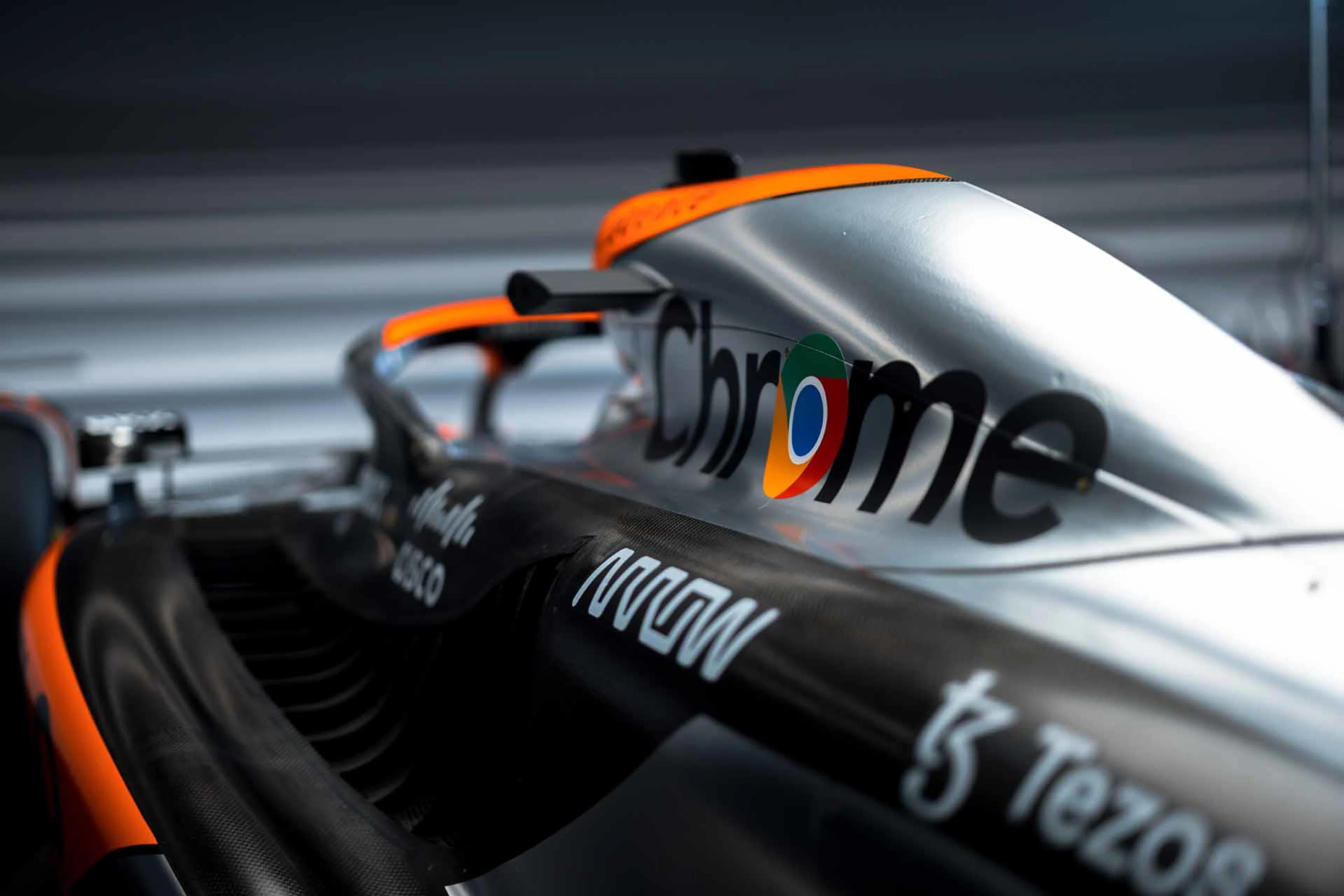
The creative work made that connection more visible. For the 2023 British Grand Prix, Google and McLaren brought back elements of the team’s historic chrome livery, connecting Google Chrome with a design that already meant something to McLaren supporters.
For me, that is a strong partnership idea. Google had a product to promote, McLaren had a piece of its history to celebrate, and fans had something more interesting to engage with than a sponsorship announcement. The brand was contributing to the experience rather than simply appearing alongside it.
That does not tell us the private financial return on the deal. But it does show what a distinctive creative connection looks like.
Nike and Michael Jordan took the relationship between brand and athlete much further. Their partnership became a product business with an identity of its own, extending well beyond Jordan’s playing career. The athlete was not simply endorsing something that already existed; he became central to what Nike was creating and selling.
Nike’s relationship with Tiger Woods illustrates another quality: commitment over time. The partnership lasted 27 years, continuing through injuries, personal controversy and sporting comebacks before ending in January 2024.
The lesson is not that a brand should stand by an athlete regardless of what happens. Supporting someone through a difficult season is different from ignoring conduct that conflicts with your values. It is that a partnership intended to build meaning over years should not be judged entirely on last weekend’s result.
Rich Energy and Haas: when attention exposes the business
Rich Energy’s arrival in Formula One had the ingredients for an interesting challenger-brand story. Here was an energy drink business putting its name on Haas and openly positioning itself against Red Bull. Its ambition to take on the established competitor was certainly not subtle.
From a marketing perspective, you can see the intended appeal. Joining the same sport as a major competitor could make a smaller brand appear more credible, more ambitious and more significant than its existing market presence might suggest.
But the story that followed became much more complicated.
In July 2019, Rich Energy’s Twitter account announced that it had terminated the Haas sponsorship because of poor performance. Shareholders then contradicted that announcement, describing it as unauthorised and saying they remained committed to the team. What should have been a commercial relationship was becoming a public disagreement about who spoke for the business.
Contemporary reporting also described an outstanding £6 million sponsorship payment and questioned the availability of Rich Energy’s drinks. Separately, the company lost a copyright case brought by Whyte Bikes over its stag’s-head logo, which was removed from the cars. The sponsorship officially ended in September 2019, after just 14 races together.
It would be difficult to put a reliable figure on the reputational damage. But those headlines were hardly the product story a challenger brand would hope to create.
This is what makes the example useful. A high-profile sponsorship does not only introduce people to your branding. It invites them to look at the business behind it.
Journalists ask questions. Potential customers try to buy the product. Partners look at whether you can deliver what you promised. Internal disagreements can become external stories.
For me, the lesson is not that young brands should avoid ambitious partnerships. It is that the ambition needs a business capable of supporting it. The funding, product availability, customer experience and decision-making all need to stand up to the attention.
A sponsorship should help the business grow, not make promises on its behalf that it cannot fulfil.
The National Guard: plenty of prospects, nobody joining
The US Army National Guard’s NASCAR sponsorship is particularly interesting because the reported problem was not a lack of attention. It was what happened to the people that attention brought in.
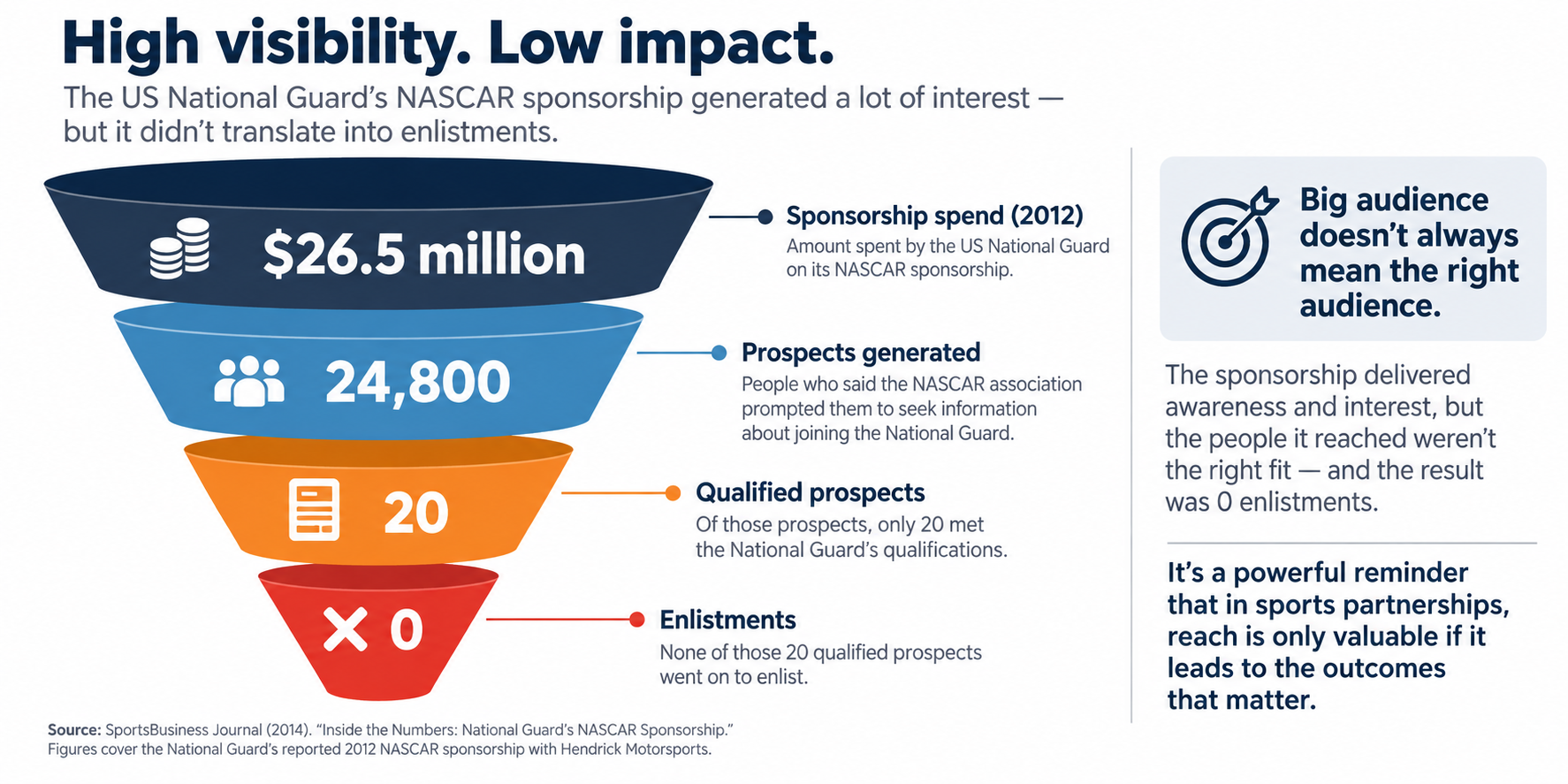
In 2012, the Guard spent $26.5 million sponsoring Hendrick Motorsports’ NASCAR programme. Reporting in 2014, based on documents examined during scrutiny of the spending, identified 24,800 recruiting prospects who said the NASCAR association had prompted them to seek information about joining. Of those prospects, only 20 met the Guard’s qualifications, and none joined.
The reported outcome was 24,800 prospects, 20 who qualified and zero enlistments from that group.
You can imagine how differently that programme might have been presented depending on where the reporting stopped. Almost 25,000 people expressing interest could look like a strong result. Follow them through qualification and recruitment, and the picture changes substantially.
There is an important qualification here. Those figures do not prove that the entire sponsorship had no value. The Guard defended the programme as a way of building awareness of military service as a career option and argued that its motorsport partnerships had contributed to its broader recruiting efforts. The reported recruitment funnel did not capture every possible indirect effect.
But that does not make the numbers irrelevant. It makes the distinction between awareness and recruitment essential.
If the objective is to build awareness, measure whether awareness increased among the people you need to reach. If the objective is recruitment, collecting contact details is only an early step. You also need people who are eligible, interested enough to continue and ultimately willing to join.
The figures alone cannot tell us precisely how much of the problem came from audience selection, the way prospects were collected or what happened afterwards. They do show why a large volume of responses should not automatically be celebrated as a successful outcome.
The same principle applies to a commercial brand. A thousand requests for a brochure might be useful. They might also be people entering a competition, looking for something free or expressing a passing interest in a product they are unlikely to buy.
The question is not just how many people responded. It is who responded, why they responded and what happened next.
The right audience matters more than the biggest audience
Before looking at sponsorship packages, I would want a clear view of the people the business needs to influence.
Where are they? What do they care about? Can they buy the product? Are we trying to reach them directly, or influence the people who help them make decisions?
A sport’s overall audience size cannot answer those questions on its own. Nielsen’s sponsorship measurement framework, for example, considers audience demographics, brand impact and sales alongside logo exposure. That is a more useful starting point than treating every viewer as equally valuable.
I would also be careful not to dismiss a sport simply because it is niche.
A specialist cycling brand might find a smaller, highly involved cycling audience more useful than a much larger general sports audience. A regional business might have a stronger commercial opportunity with a local club than with a globally recognised team whose supporters mostly live elsewhere.
Neither is automatically the better investment. The fit, the price and the opportunity to do something meaningful with the relationship are what matter.
Equally, being a fan of a team is not a business case for sponsoring it. Personal enthusiasm can help drive a partnership, but it should not replace an honest assessment of whether the customers share that enthusiasm.
The business needs to be ready, not simply willing
There is no universal point in a brand’s life when sports sponsorship becomes the right decision.
An early partnership could support a well-funded launch, introduce a product to the right people or give a business a credible way into a new market. Waiting until the brand is already established could mean missing a useful opportunity.
But entering early and entering unprepared are different things.
I would want to understand whether the product is available where the partnership will generate interest, whether the business can respond to demand and whether the commitment is affordable beyond the first payment.
I would also look at what the deal would prevent the business from doing.
A sponsorship might look affordable in isolation while leaving too little money for distribution, customer acquisition, creative work or the team needed to deliver it. That is particularly important when the agreement runs for several years but the business is still working out where its growth will come from.
The decision should be based on the resources the company can realistically commit, not the revenue it hopes the announcement will somehow create.
Signing the deal is only the start of the work
When evaluating a partnership, I would build the delivery plan alongside the commercial proposal.
What are we actually going to do with it? What will customers see? What will fans get from the relationship? Who will manage the work, and what will it cost?
That might include content, product demonstrations, retail activity, customer experiences, hospitality or campaigns built around the team and its athletes. The right combination depends on the objective.
The detail of the rights matters too. How much athlete access is available? Which assets can be used, in which markets and through which channels? How long do approvals take? Are there restrictions that would prevent the most useful creative ideas from happening?
It is possible to be offered an impressive collection of rights that the business has neither the budget nor the capacity to use. I would rather negotiate for the things a team can deliver well than pay for a long list that looks good in a presentation.
McLaren and Google’s chrome livery is a useful reference here: the creative idea gave the partnership something tangible to say. That should be part of the thinking before the deal, rather than something the marketing team is expected to invent afterwards.
A losing team does not automatically make a bad investment
Sporting performance matters, but I would be wary of using trophies as the main measure of sponsorship success.
A team can have a disappointing season and still give a brand useful access to supporters, customers and commercial partners. An athlete can lose a competition while remaining highly relevant to the people the brand wants to reach.
The reverse is also worth considering. A championship win is an exciting moment, but it does not resolve a poor audience fit or make an unsuitable product easier to sell.
That is why I would test the business case against an ordinary season, not just the most optimistic one.
Does the partnership still make sense without a title? What happens if the athlete is injured, the team is relegated or the expected exposure falls? Which parts of the plan remain valuable, and which depend on success that nobody can guarantee?
The National Guard case is a reminder to keep those questions separate. Whatever happened on the track, the reported recruitment funnel still ended without an enlistment from that group. Sporting success and business success need their own measures.
Agree what success looks like before you start
The first question I would ask a business considering sponsorship is straightforward: what do you need this investment to achieve?
Building recognition in a new market is different from generating qualified enquiries. Supporting a premium position is different from opening conversations with distributors. All might be legitimate objectives, but they require different partnerships, different activity and different evidence of progress.
I would establish a starting point before launch, agree a small number of meaningful measures and decide when the investment will be reviewed.
For an awareness objective, that could mean tracking recognition and consideration within the target audience. For lead generation, it means following people through qualification and conversion rather than stopping at an enquiry total. For a commercial partnership, it might mean measuring the relevant relationships and opportunities it helps create.
Where practical, I would also look for a comparison with similar audiences or markets not exposed to the activity. An increase in sales during a sponsorship period does not, by itself, establish that the sponsorship caused it.
And I would keep exposure estimates in their place. An estimate of equivalent advertising value is not money the business has earned.
Long-term brand-building deserves time. It also deserves a clear explanation of what is being built and how the business will know whether it is working.
The right partnership starts with the right questions
Sports partnerships can be an exceptional way to build a brand. The opportunity to combine creative work, customer experiences and commercial relationships is a large part of what makes them interesting.
But I would not start by asking which team has space available or which athlete is looking for a sponsor.
I would start with the business: its goals, its audience, its resources and its readiness. Then I would compare the available opportunities, including whether sponsorship is the best use of the budget at all.
Google and McLaren show the creative potential of a well-considered connection. Rich Energy shows the risks of stepping into a highly public relationship when the business behind it becomes the story. The National Guard shows why attention and responses need to be followed through to the outcome that matters.
This is where an experienced CMO or Head of Marketing can make a useful contribution: assessing the fit, challenging the assumptions and building a plan that extends beyond the announcement.
If your business is considering a sports partnership, get in touch. I help brands evaluate the opportunity, build the commercial case and plan how to make the relationship work before committing to it.